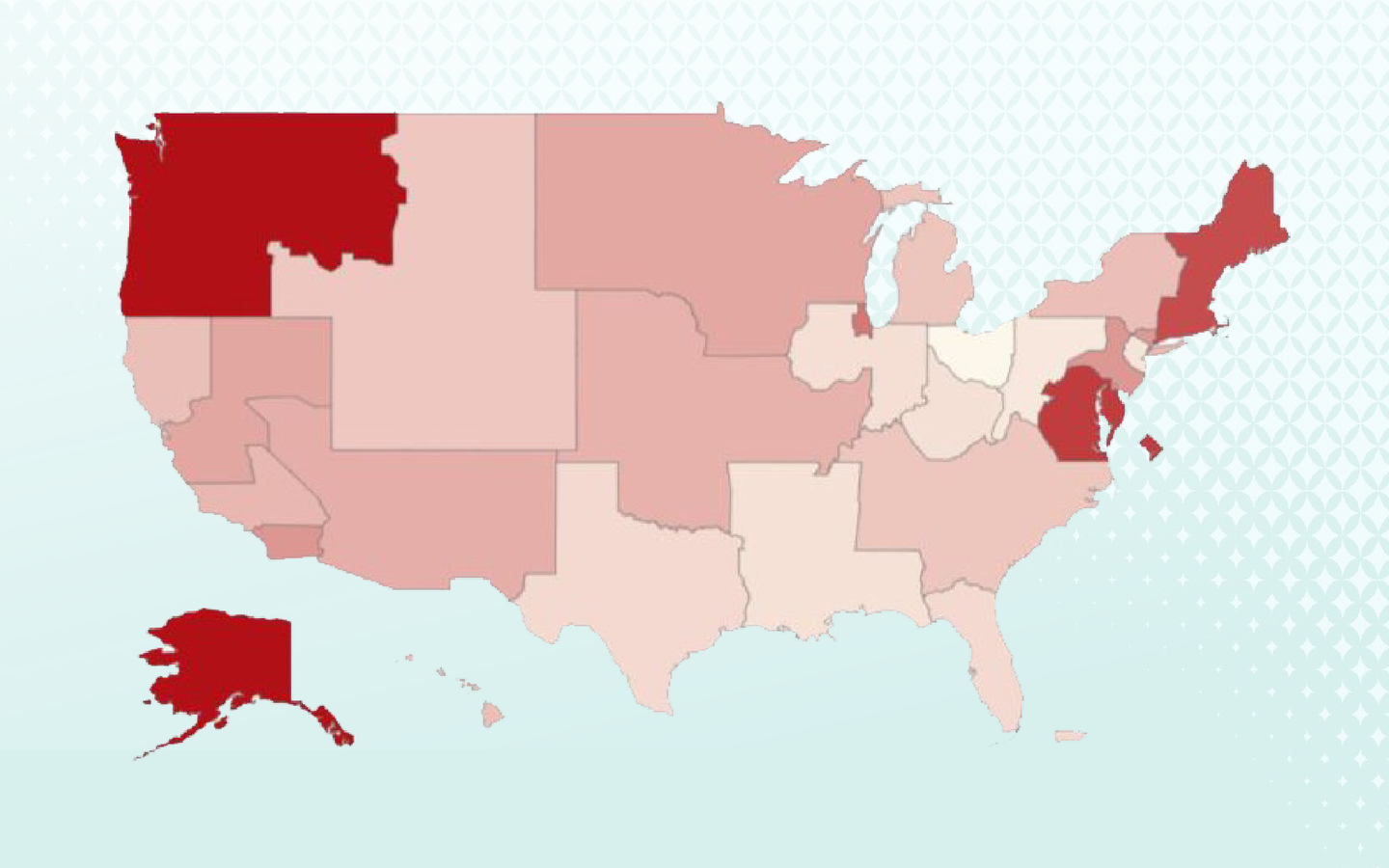
State Survey of Immigration Laws
Prepared by The Global Immigration Practice Group
Fisher & Phillips LLP advises employers on all areas of U.S. business immigration law. We assist employers in obtaining visas for non-resident employees, such as temporary workers, professionals, and intra-company transferees. Our team has extensive experience handling B-1/B-2, E-1/E-2/E-3, F-1, H-1B, H-2B, H-3, J-1, L-1, O-1, Q-1 and NAFTA Treaty matters. We also have extensive experience handling permanent residence matters, in all categories, and guiding employers through the maze of bureaucracy and procedure from labor certification through adjustment of status or consular processing at a U.S. consulate or embassy. Furthermore, Fisher & Phillips LLP provides assistance to clients with respect to their global immigration needs. This includes obtaining visas for U.S. workers being transferred abroad, as well as assisting in the transfer of key personnel from one country to another anywhere in the world.
We advise employers on compliance with U.S. employment verification requirements, train supervisors in I-9 compliance, represent clients in verification audits, and defend immigration discrimination claims. Additionally, we conduct internal audits for our clients to identify and correct potential problem areas before a government audit occurs. Finally, we provide our clients with a comprehensive, web-based I-9 verification solution. Our Electronic I-9 Solution produces virtually failsafe I-9s, increases overall efficiency of I-9 processes, and provides centralized visibility and management of corporate-wide I-9 risks. It interfaces seamlessly with the E-Verify database, if desired. Our Electronic I-9 Solution helps protect your business by making it easier to complete and store I-9 forms.
This survey of state immigration laws provides an overview of recent legislation. Because so many states are enacting immigration-related legislation affecting employers, it is becoming increasingly important for employers to know what legislation applies in the states they do business. This is especially true for employers who operate in multiple states. While we make every attempt to cover each enacted piece of legislation, this list is only a guide and you should speak with an attorney before making any decisions based upon this list. Some counties or municipalities may also have enacted immigration-related legislation that will not be included on this list.
If you have any questions about this state law survey or any other immigration-related matter, please contact an attorney in our Global Immigration Practice Group at (404) 240-4224 or via email at immigration@laborlawyers.com.
Arizona
HB 2779 – Fair and Legal Employment Act
Effective date: January 1, 2008
Requires all businesses in the state to use E-Verify to verify the employment eligibility of newly hired employees. A business found to be employing undocumented immigrants would benefit from a rebuttable presumption that it did not violate another provision in the state law prohibiting intentionally or knowingly employing undocumented workers if the business was enrolled in E-Verify at the time of the alleged violation. The law stipulates that any company knowingly or intentionally hiring an illegal alien could face suspension of its business license for a first offense, and revocation of the license for a subsequent offense. The law has faced several legal challenges. On September 17, 2008, the U.S. Court of Appeals for the Ninth Circuit affirmed a ruling by the U.S. District Court for Arizona upholding the Act. Later, on March 19, 2009, the same Court of Appeals refused to hear a second challenge to the law filed by various business and pro-immigration plaintiffs.
SB 1070
Signed: April 23, 2010
Effective date: Approx. August 2010 (90 days from the close of the legislative session.)
The stated purpose of this law is to "discourage and deter the lawful entry and presence of aliens and economic activity by persons unlawfully present in the United States." The following is a summary of some of the law's provisions:
1.) Law enforcement officers are required to determine the immigration status of a person if "reasonable suspicion" exists that the person is unlawfully present in the U.S.
2.) Officials and agencies must make a reasonable attempt to determine the immigration status of a person if "reasonable suspicion" exists that the person is unlawfully present in the U.S.
3.) Whether on private or public land, a person is guilty of trespassing, a class 1 misdemeanor, if he or she is not carrying his or her alien registration card or willfully failed to register. People in violation will be required to pay jail cost and a fine of at least $500 for the first violation and at least $1,000 for subsequent offense.
4.) Targeted at day laborers, it is a class 1 misdemeanor for a occupant of motor vehicle that is stopped on a street, roadway or highway and blocking traffic to attempt to hire or hire and pick up passengers for work. Likewise, it is a class 1 misdemeanor for a person to enter a motor vehicle that is stopped on a street, roadway, or highway and blocking traffic in order to be hired for work.
5.) It is a class 1 misdemeanor for a person unlawfully present in the U.S. to solicit work in a public place or perform work as an employee or independent contractor in Arizona.
6.) It is unlawful to transport or move, conceal, harbor or shield a person in Arizona if you know they are unlawfully present in the U.S. Further, it is unlawful to encourage or induce a person to come to or reside in Arizona if the person knows or recklessly disregards the fact that coming to, entering, or residing in Arizona is against the law. These offenses are class 1 misdemeanors and punishable with fines of at least $1,000. If the violation involves 10 or more illegal aliens it is a class 6 felony with a fine of at least $1,000 for each alien involved.
7.) Employers are required to keep verification records of their employees' work eligibility using E-Verify for the duration of employment or 3 years, whichever is longer. It a class 3 felony for an employer to fail to verify employment eligibility using E-Verify or keep verification records.
For additional information and the text of bill please visit the Arizona State Legislature's website.
Arkansas
HB 1024 (Act 157)
Effective date: August 1, 2007
This law prohibits Arkansas state agencies from entering into contracts with businesses that knowingly employ or contract with illegal immigrants. Contractors are required to certify that they do not, at the time of certification, employ or contract with undocumented workers. If a contractor uses subcontractors, the subcontractors must also certify that they do not employ any unauthorized workers. Contractors who are found to have employed unauthorized workers may be found in breach of the contract and may be liable to the state for any actual damages incurred. The certification requirement applies to all contractors seeking to enter into a contract with a state agency for professional services, technical and general services, or construction where the value of the contract is $25,000 or more.
California
Lancaster – Ordinance 934
Effective date: January 1, 2010
Requires all employers to verify the employment eligibility of all newly hired employees using E-Verify. For first violation, employer will be required to terminate all workers hired in violation of ordinance. For second violation, city manager may revoke any license issued to employers who hired unauthorized workers.
Mission Viejo – Ordinance 07-260
Effective date: July 1, 2007
Requires the city and employers with city contracts to verify the employment eligibility of new hires using E-Verify. Employers in violation will not be permitted to enter into city contracts.
Colorado
HB 06-1343 (C.R.S. 8-17.5-101 et seq.)
Effective date: August 7, 2006
Applies to contractors who provide services to state agencies and political subdivisions of the state, broadly defined to include most state and local governments, districts, and other public entities. Public contracts for services must include provisions which: (1) prohibit the contractor from knowingly employing or contracting with illegal aliens, or using subcontractors who do so; (2) require the contractor to participate in the federal "E-Verify Program" to verify that it does not employ illegal aliens; and (3) require the contractor to take specified actions if it learns that a subcontractor is employing illegal aliens. Violation of these provisions will constitute a breach of contract, allowing the public entity to terminate the contract and recover damages. The Secretary of State will maintain a list of all terminated contractors. The Department of Labor and Employment is authorized to investigate compliance and its web site provides a complaint form for reporting violations.
HB 06S-1001, (C.R.S. 24-46-105.3)
Effective date: October 1, 2006
Provides that in order to be eligible for state economic development incentives, an employer must provide proof that it is in compliance with IRCA. Under this law, employers who do not comply with IRCA may be required to repay economic development incentives received from the state and may be disqualified for five years from receiving any further incentives. Employers receiving economic development funds from the state must also allow the state to inspect the employers' I-9 documentation.
HB 06S-1017, (C.R.S. 8-2-122)
Effective date: January 1, 2007
Requires each employer in Colorado to attest that the employer has verified the legal work status of each employee and retained file copies of the appropriate federally-required documentation, that the employer has not altered or falsified the employee's identification documents, and that the employer has not knowingly hired an unauthorized alien. Each Colorado employer must also submit documentation, upon request, to the Colorado Labor and Employment Department demonstrating compliance with federal employment verification requirements. The law authorizes the state labor agency to conduct random audits of employers to ensure compliance with federal law, and subjects an employer to a fine of up to $5,000 for the first offense and up to $25,000 for the second or subsequent offense. The act applies only to employees hired on or after January 1, 2007.
HB 06S-1015, (C.R.S. 39-22-604)
Effective date: January 1, 2008
Requires the office of innovation and technology to create an online employment authorization verification system. The statute further requires employers to withhold state income tax at the rate of 4.63% for certain employees who do not provide the employer with a validated tax identification number issued to a U.S. resident.
HB 06S-1020 (approved as "Referendum H")
Effective date: January 1, 2008
Prohibits employers from claiming a state income tax deduction for wages or remuneration of $600 or more paid to an individual who was known at time of hire to be an unauthorized alien, regardless of whether the individual is an employee or independent contractor, if the payment is for services performed in Colorado. The law includes several exceptions, including payments to individuals hired before the effective date of the law, payments to individuals who present to the employer a valid license or identification card issued by the Department of Revenue, and payments that are not made directly to the unauthorized individual. issued to a U.S. resident.
Georgia
SB 529 – Georgia Security and Immigration Compliance Act
Effective date: July 01, 2007 (passed on April 18, 2006)
The Act requires among other provisions that public employers and contractors with the State verify the work eligibility of newly hired employees using the federal government's E-Verify system. Section 2 of SB 529 has three effective dates for public employers and contractors, including subcontractors, to participate in the federal work authorization program to verify the status of newly hired employees: (1) effective July 1, 2007, for every public employer and contractor, including every subcontractor, who has 500 or more employees, (2) effective July 1, 2008, for every contractor, including every subcontractor, who has 100 or more employees, and (3) effective July 1, 2009, for every contractor, including every subcontractor, who has 99 or fewer employees. The Georgia Labor Commissioner and the Department of Transportation shall promulgate rules to effectuate this Code Section including, implementing a state work authorization program.
SB 184
Effective date: January 1, 2008
This law prohibits employers from claiming a state income tax deduction for wages or remuneration of $600 or more paid to an individual who is not authorized to work. The employer's reliance on E-Verify provides a safe harbor, as does the employee's presentation to the employer of a valid license or identification card issued by the Georgia Department of Driver Services. The law only applies with regard to employees hired after January 1, 2008.
HB 2
Effective date: January 1, 2010.
Public employers required to participate in E-Verify are required to post their federally issued E-Verify user identification number and date of authorization to use E-Verify on their website. Covered entities that do not maintain a website must annually publish the identification number and date of authorization in the legal organ for the county.
Any state agency providing or administering a public benefit is required to make applicants sign an affidavit verifying the applicant's lawful presence in the United States. An applicant's lawful status should be checked using the Systematic Alien Verification of Entitlement (SAVE) program.
Hawaii
HB1750 - Act 052
Effective date: July 1, 2007
All persons seeking employment with the government of the State or in the service of any county shall be citizens, nationals, or permanent resident aliens of the United State, or eligible under Federal law for unrestricted employment in the United States.
HB643
Effective date: July 1, 2009
Authorizes the contractors license board to suspend, revoke, or refuse to renew a contractor's license for employing a worker on a public work project who is ineligible under federal law to work in the United States.
Idaho
HB 577
Effective date: March 11, 2006
Limits unemployment benefits to citizens and legal residents.
Executive Order 2006-40
Effective date: December 13, 2006
This order requires the state's personnel department to ensure that all new state employees have proper work authorization. The state must also ensure that "contracts for services performed for the State in Idaho are with businesses" that employ only legal workers, and that health, welfare, and unemployment benefits go only to legal residents.
Illinois
The United States of America vs. the State of Illinois
Effective date: March 11, 2009
On March 11, 2009, a federal district court judge ruled as unconstitutional an Illinois state law that had prohibited the use of E-Verify within the state. The case, entitled The United States of America vs. the State of Illinois, was originally filed on September 24, 2007. Brought by the Justice Department on behalf of the Department of Homeland Security, the civil suit was intended to preempt an Illinois state law that barred businesses from using E-Verify until the system was proven to be faster and more accurate. While the litigation was pending, the State of Illinois said it would not enforce the act. Because of the decision in this case, there are no longer any state law restrictions on Illinois employers voluntarily using the E-Verify system.
Right to Privacy in the Workplace Act Amendment
Effective date: January 1, 2010
Illinois employers conducting business in the state choosing to enroll in the federal government's E-Verify system are required to complete an attestation form, attesting that: 1.) Employer and all employees using the E-Verify program have received the E-Verify training materials and completed the online training conducted by the Department of Homeland Security. 2.) Employer has posted the required E-Verify notice from Department of Homeland Security in a place that is clearly visible. 3.) Employer maintains the original signed attestation form and makes available for copying and inspection at the request of the Department. 4.) Employer has posted in a place that is clearly visible the required anti-discrimination notice issued by the Office of Special Counsel for Immigrant-Related Unfair Employment Practices. Employers must complete this attestation form at the time of enrollment or by January 30, 2010, if already enrolled in the E-Verify. This law does not require Illinois employers to use the E-Verify system.
Iowa
SF 562
Effective date: July 1, 2007
Any business that receives economic development assistance from the state of Iowa must be subject to contract provisions stating that all of the business's employees are citizens of the United States who reside within the U.S. or are authorized to work in the U.S. pursuant to federal law, including legal residents in the U.S. states. Any business that receives public moneys must adhere to such a contract provisions and provide periodic assurances, as the state requests, that the jobs are filled solely by individuals authorized to work in the U.S.
Kansas
HB 2157
Effective date: March 23,2006
Limits unemployment benefits and employment protection status to citizens and those with legal immigration status. Immigrants who were admitted into the United States legally and completed work during this time period are also eligible for benefits for that specific time period only (section 1:4:C:m).
SB 108
Effective date: April 15, 2006
Provides employment security measures and unemployment benefits to legal residents of the state. Qualifying terms of employment do not include those immigrants who were admitted under certain legal circumstances to perform agricultural services (section 4).
Louisiana
SB 753
Effective date: June 23, 2006
Allows any state agency or department to conduct an investigation of a contractor's hiring policies if the employment of unauthorized immigrants is suspected. The district attorney can issue an order to fire undocumented workers, and, if the contractor does not comply within ten days of receiving notice, the contractor is subject to penalties of up to $10,000. This applies only to contractor's employing more than 10 people (section 1).
Massachusetts
Executive Order 481
Effective date: February 23, 2007
Prohibits any state agency in the Executive Branch from contracting with businesses that employ unauthorized workers. Any contractor doing business with an Executive Branch agency must certify that it will not use unauthorized workers.
Minnesota
Executive Order 08-01
Effective date: January 29, 2008
Requires that E-verify be used to check the work authorization of all newly hired employees for the following: all entities within the executive branch of state government and all companies awarded new state contracts worth more than $50,000, or whose qualifying contracts are amended after the executive order's effective date. Further, all contractors and subcontractors doing business with the state must certify that they do not knowingly hire unauthorized workers. Companies that are found to be in violation may face cancellation of state contracts, and possible permanent prohibition from doing business with the state.
Mississippi
HB 381
Effective date: April 21, 2006
Increases the penalties for a person found guilty of human trafficking of any kind to a possible prison sentence of up to 20 years. A person found guilty of recruiting a minor for employment in the sex industry can receive a prison sentence of up to 30 years (section 3). Destroying or threatening to destroy immigration documents for the purposes of restricting travel will result in a prison term of no more than 5 years. (section 4).
SB 2988
Effective date: July 1, 2008 (signed March 17, 2008)
The Mississippi Employment Protection Act mandates phased-in use of E-Verify, and provides for stiff penalties for non-compliance. The Act requires all state agencies, public contractors and subcontractors, and all private employers with 250 or more employees, to begin using E-Verify to check the status of new hires as of July 1, 2008. Private employers with 100-249 employees must begin using E-Verify to check the status of new hires as of July 1, 2009 and those with 30 to 99 have until July 1, 2010. All remaining employers must begin using E-Verify by July 1, 2011.
Penalties for non-compliance include the cancellation of any state or public contracts, and ineligibility for any state or public contract for up to 3 years. Furthermore, the employer may have its business license revoked for up to 1 year. Use of E-Verify provides a safe harbor, however, from non-willful violations of the Act. Also under the law, workers who accept unauthorized employment face a felony conviction, 1 to 5 years incarceration, and a fine of $1,000 to $10,000.
The law includes a provision making it a discriminatory practice for an employer to terminate a work-authorized employee while retaining a non-work authorized employee, if the two employees have substantially similar job duties. An employer is indemnified under this provision; however, if it is properly using the E-Verify system.
SB 2448
Effective date: April 25, 2007
Limits unemployment benefits to U.S. citizens or permanent residents.
Missouri
HB 390
Effective date: July 7, 2009
Provides that no business shall knowingly employ any individual who is not authorized to work in Missouri. Also mandates that for any public contract or grant in excess of $5,000 (including subsidized tax credits and loans), an employer must submit annually a sworn affidavit confirming its use of E-Verify for all employees working in connection with the contracted services. The affidavit must also confirm that the employer does not knowingly employ any person who is an unauthorized alien in connection with work done on a public contract.
HR 1549
Effective date: July 08, 2008
Employment-related provisions take effect January 1, 2009. This law requires all state agencies and local governments to register and use E-Verify. Private companies who receive state loans, tax credits or have a state contract worth more than $5,000 must also register and use E-Verify. Companies found to have hired undocumented workers are subject to suspension of business permits/licenses. Penalty for repeat violations of hiring undocumented workers is one-year suspension of business license, followed by permanent revocation for repeat offense. Businesses with state contracts are subject to cancellation of those contracts if found to be in violation of this law, including eventually a permanent bar from contracting with the state.
Mo. Rev. Stat. 8.283
Effective date: August 28, 2007
If a state agency has reasonable evidence that a contractor doing "work" for the state is employing unauthorized workers, the state agency must order that contractor to terminate the suspected illegal workers. The agency may also withhold payment of 20% of the contract's value where the contractor has employed unauthorized workers. This amount can be doubled where the contractor is shown to have hired a subcontractor which the contractor knew was using illegal labor. A contractor found in violation of this statute is prohibited from entering into state contracts for two years.
Executive Order 07-13
Effective date: March 07, 2007
Reiterates a September 2006 executive order that mandated state agencies to verify the work authorization of all new hires through the federal government's electronic verification system. The order also requires that each state agency audit all contractors with which it does business to ensure that those contractors employ only legal workers; if illegal workers are discovered, the agency is empowered to end any contract with the offending contractor. All future contracts will be required to empower state agencies to cancel contracts without penalty if a contractor is discovered to be using illegal labor. Furthermore, contractors must affirm that all employees are eligible to work in the United States.
Montana
HB 111 - Chapter 52
Effective date: January 1, 2008 (signed March 27, 2007)
Revises unemployment insurance laws. Exclusions from definition of employment: services performed by an alien as identified in 8 U.S.C. 1101, i.e. an alien having a residence in a foreign country coming temporarily to the United States to perform agricultural labor or services, or an alien, who is a bona fide student and who seeks to enter the United States temporarily and solely for the purpose of pursuing such a course of study.
SB 214 – Chapter 340
Effective date: July 1, 2007 (signed – April 28, 2007)
Revises laws relating to independent contractors. Exclusions from definition of employment: services performed by an alien as identified in 8 U.S.C. 1101, i.e. an alien having a residence in a foreign country coming temporarily to the United States to perform agricultural labor or services, or an alien, who is a bona fide student and who seeks to enter the United States temporarily and solely for the purpose of pursuing such a course of study.
Nebraska
LB 403
Effective date: October 1, 2009 (signed April 08, 2009)
All public employers and any contractors and subcontractors awarded a contract by a public employer for the physical performance of services within the state of Nebraska are required to use E-Verify to determine the work eligibility status for all new hires. Qualifying contracts between a public employer and a contractor must contain a provision requiring the contractor to use E-Verify. Tax incentives under various development and advantage acts are available for qualified private employers who use E-Verify.
Nevada
AB 496 - Chapter 537
Effective date: July 1, 2007 (signed June 15, 2007)
Makes various changes concerning workers' compensation. The provisions of the act do not apply in favor of aliens who are nonresidents of the United States at the time of the accident, injury to, or death.
AB 383 – Chapter 316
Effective date: October 1, 2007 (signed June 02, 2007)
This law creates and defines the crime of human trafficking making it a category B felony with a sentence of 1-20 yrs, pending degree, in state prison and a fine of no more than $50,000 and makes the crime one for which an individual may be charged as a habitual felon. Individuals suffering injury as a result of the act of this crime can recover actual and punitive damages in civil action with the personal property of the convicted felon subject to forfeiture. Employment Provisions: Requires the Director of the Department of Business and Industry to include on the Department's website a link to the Social Security Administration where verification can be performed by employers. The Nevada Tax Commission is also to hold hearings concerning anyone who has been found to be engaged in unlawful hiring or employment of unauthorized aliens and if necessary impose administrative fines.
New Mexico
HB 247 – Chapter 137
Effective date: July 1, 2007 (signed April 2, 2007)
Concerns unemployment compensation, excludes certain aliens admitted to the United States to perform service in agricultural labor pursuant to INA.
North Carolina
SB 1523
Effective date: January 1, 2007
Requires any North Carolina State agency, department, institution, community college, or local education agency to use the E-Verify system on all employees hired after January 1, 2007. Local education agencies have until March 1, 2007 to comply.
Oklahoma
HB 1804 – Oklahoma Taxpayer and Citizen Protection Act of 2007
Effective date: November 1, 2007 (signed May 8, 2007)
The Act states that no public employer shall enter into a contract for the physical performance of services within the state unless the contractor registers and participates in the E-Verify Program to verify the work authorization status of all new employees. The Act also requires that any contractor or subcontractor who enters into a contract with a public employer in connection with the physical performance of services within the state shall register and participate in the E-Verify Program to verify information of all new employees. The law includes a provision making it a discriminatory practice for an employer to terminate a work-authorized employee while retaining a non-work authorized employee, if the two employees had substantially similar job duties. An employer is indemnified under this provision, however, if it is properly using the E-Verify system. In June 2008, the U.S. District Court for the Western District of Oklahoma granted a preliminary injunction postponing enforcement of the employment-related provisions of the Act. On August 25, 2008, the state appealed the ruling to the Tenth Circuit Court of Appeals.
Oregon
HB 2244/SB202
Effective date: January 1, 2008 (signed June 1, 2007)
Requires the Department of Consumer and Business Services to develop a plan to eliminate the sunset of provisions related to permanent partial disability awards in workers' compensation claims. If the worker is a person present in the United States in violation of federal immigration laws, the insurer or self-insured employer shall cease payments.
Pennsylvania
HB 2319 - The Prohibition of Illegal Alien Labor on Assisted Project Act
Effective date: July 1, 2006 (signed May 11, 2006)
The bill defines an illegal alien as one who violates federal immigration laws yet is a paid employee within the state. This bill prohibits the use of labor by illegal immigrants on projects financed by grants or loans from the state government. Appropriate federal authorities should be contacted in the event a contractor knowingly employs illegal aliens and continues to accept a state contract (section 3).
SB 1412 / Act 2008-79
Effective date: September 9, 2008 (signed July 10, 2008)
Amends the Keystone Opportunity Zone ("KOZ") economic development program. The KOZ program provides tax benefits (such as exemptions, deductions, abatements or credits) to businesses located or operating in a keystone opportunity zone, expansion zone, or improvement zone. The amendment requires the repayment of the full value of any KOZ tax benefit received in prior years if the taxpayer is sentenced under federal law for knowingly using the labor of an illegal alien on the contract OR a contractor used by the taxpayer is sentenced under federal law for the same offense and the taxpayer knew or had reason to know that the contractor was employing an illegal alien on the contract. If the taxpayer is required to repay the tax benefit under this section, the taxpayer will be ineligible to reapply for the benefit for two years. Under the law, a certificate of compliance from the contractor that it is in compliance with the regulations of Section 274A of the Immigration Reform and Control Act of 1986 ("IRCA") will be an affirmative defense to a violation.
Rhode Island
Executive Order 08-01
Effective date: March 27, 2008
Mandates that all agencies and departments within the executive branch of the State of Rhode Island government must begin using E-Verify. Furthermore, all persons and businesses (including contractors) doing business with the State must also register and use E-Verify.
South Carolina
South Carolina Illegal Immigration Reform Act
Effective date: January 1, 2009 (signed June 4, 2008)
This bill creates an implied business license for any private employer in the state. This license is revoked if the employer does not properly verify that a newly hired employee has valid work authorization. Employers can do so by completing a Form I-9 and either: (1) verifying the employee's information through the federal E-Verify system; or (2) checking that the employee has a valid South Carolina driver's license or identification card issued by the SC Department of Motor Vehicles, is eligible to obtain a SC driver's license or ID card, or possesses a driver's license or ID card from another state that meets SC's eligibility requirements. Verification under this law must be completed within five business days of the employee starting work. Employers who elect the E-Verify option (rather than the drivers license or identification card option) are presumed to be in compliance with the law. Employers with state service contracts must begin compliance as of January 1, 2009. Private employers with 100+ employees must begin compliance by July 1, 2009 and private employers with less than 100 employees must begin compliance no later than July 1, 2010.
The Act expressly states that a private employer shall not "knowingly or intentionally" employ an unauthorized alien, and imposes a system of penalties for employers who violate either the verification of employment provisions or the prohibition on hiring an unauthorized alien. A private employer can be assessed a civil penalty of not less than $100 and not more than $1,000 for each violation. For a first violation, employers can avoid the assessment of a penalty by complying with the verification provisions within 72 hours of notification of a violation. For any subsequent violation, the employer will be assessed a civil penalty.
If an employer knowingly or intentionally hires an unauthorized alien, the penalties involve either suspension or revocation of the employer's imputed license, thereby preventing the employer from hiring new employees or conducting business within the state of South Carolina. Additionally, in order to obtain reinstatement of the employer's license, the employer must terminate the unauthorized alien, and pay a reinstatement fee of not more that $1,000. Subsequent violations of this portion of the Act can result in revocation of an employer's license for a period of five years.
Tennessee
S 294
Effective date: January 1, 2009
Makes it a misdemeanor offense to knowingly manufacture, provide, transfer, or submit to any other person false identification for the purpose of obtaining or maintaining employment. Each false identification document used constitutes a separate offense. Anyone convicted for a violation of this act who is found to be unlawfully present in the United States will be referred to the Department of Homeland Security.
HB 111
Effective date: January 1, 2007 (enrolled June 1, 2006)
Prohibits contractors from contracting with state agencies within one year of the discovery that the contractor employs illegal immigrants (section 1). Contractors must also attest that they do not employ illegal workers.
HB 729
Effective date: January 1, 2008 (signed 06/26/2007)
Creates the criminal offenses of recklessly employing an illegal alien, knowingly employing an illegal alien, and knowingly encouraging or inducing an illegal alien to enter the state for the purpose of employing such illegal alien. Provides for fines up to $50,000. Farmers are exempt from the new rule. They are not required to have business licenses. A suspension would be lifted once the company proves it no longer has any illegal immigrants as employees. Subsequent offenses occurring within three years would mandate license suspensions for one year. Employers who check identification and are misled by an illegal immigrant will not be considered to be in violation and would not be prosecuted.
SB 903 – Chapter 220
Effective date: May 24, 2007 (signed May 24, 2007)
Prohibits the use in the state of a federal individual taxpayer identification number as a form of identification to prove immigration status. Provides that for purposes of an application or offer of employment, no person in this state shall accept an individual taxpayer identification number as a form of identification and any person, including any contractor, in this state who is presented with an individual taxpayer identification number by a potential employee or subcontractor as a form of identification or to prove immigration status shall reject such number and shall request the lawful resident verification information.
Texas
HB 1196
Effective date: September 1, 2007 (signed June 15, 2007)
Relates to restrictions on the use of certain public subsidies to employ undocumented workers, provides that a public agency, state or local taxing jurisdiction, or economic development corporation shall require a business that submits an application to receive a public subsidy to include in the application a statement certifying that the business, or a branch, division, or department of the business, does not and will not knowingly employ an undocumented worker.
Utah
SB 81
Effective date: July 1, 2009 (signed June 4, 2008)
Requires all public employers to register and use the E-Verify system for all new employees; requires all contractors and subcontractors who have contracts with the state for the "procurement of services" to use E-Verify. A later law, SB 39, clarified that a covered contract under this act is defined as "an agreement for the procurement of services that is awarded through a request for proposals process with a public employer." SB 81 also makes it unlawful to discharge an employee while retaining an unauthorized worker in the same job category; makes it a crime to transport an illegal alien into the state or for 100 miles within the state, or to conceal, harbor, or shelter illegal aliens from detection, for commercial advantage or private financial gain.
SB 251
Effective date: July 1, 2010
Requires private employers with 15 or more employees to register with and use a status verification system to verify the federal legal working status of any new employees. Only exceptions are those private employers of foreign workers in H-2A or H-2B visa status. It also authorizes the Utah Department of Commerce to begin publishing a list of businesses registered with a verification system. Employers in violation are prohibited from entered into a state contract and may be held civilly liable under state law for unlawfully hiring an unauthorized alien.
Virginia
HB 2294
Effective date: March 27, 2007 (signed March 27, 2007)
An Act relating to the Virginia Workers' Compensation Act; employees of local governments. As the legislation pertains to immigrants, it defines the term "aliens and minors" as being capable of definition as an employee.
HB 1298
Effective date: July 1, 2008
Makes it a criminal offense under state law to properly complete and maintain an I-9 Form for each newly hired employee, as required by the federal Immigration and Reform Control Act. Authorizes state licensing boards to suspend the professional license of any employer which is found to have hire an unauthorized worker. Subsequent violations can result in up to a $2,500 fine per violation.
HB 926
Effective date: July 1, 2008
Provides that business who are convicted of a pattern and practice of hiring unauthorized workers can face suspension of their right to conduct business in the state.
HB 737
Effective date: December 1, 2012
Requires state agencies to enroll in E-Verify and to use it for each newly hired employee who is to perform work within the Commonwealth of Virginia.
Washington
SB 6885
Effective date: March 9, 2006 (signed March 9, 2006)
Excludes labor performed by nonresident aliens from the definition of "employment" when establishing unemployment insurance benefits (section 22).
West Virginia
West Virginia Code §21-1B-2
Effective date: April 19, 2007 (Signed April 3, 2007)
This state law requires employers to verify the work authorization of all employees. The state's commissioner of labor may inspect the personnel documents of any employer to ensure proper work authorization for that employer's workers. An employer who employees unauthorized workers is guilty of a misdemeanor, punishable by fines of up to $10,000 and incarceration for repeat offenses. The law prohibits employers from claiming a state income tax deduction for wages or remuneration of $600 or more paid to an individual who is not authorized to work, but only if the employer has been convicted of unlawfully hiring unauthorized workers. Repeat offenses of the law may result in suspension or revocation of the employer's business license.
A more detailed description of some of the foregoing laws can be found among our Global Immigration Alerts.